Showing posts with label work. Show all posts

Thursday, October 17, 2013

Catching up #2...Deptford X 2013

Continuing my blue and white theme, but changing the focus to the local campaigns I've been involved in, my Deptford X project this year was about my town's maritime heritage.


I joined forces with two other artists, David Aylward and Laura X Carlé to produce an "Anchor Fest" under the umbrella title "Deptford Is Forever". (www.deptfordisforever.net).

Our aim was to draw attention to the Deptford Anchor which used to sit at the top of Deptford High Street. It was removed earlier this year by the Council as part of regeneration works being done to the high street. Originally the anchor had been installed in 1990 as part of previous regeneration works, but was mounted on a low plinth that over the years had became a sit-down gathering point for the local street drinkers – in full view of the A2 traffic into and out of central London. Undoubtedly, the anchor's removal was intended to displace the street drinkers. A not very well publicised consultation took place in 2012 asking people if the anchor should stay in Deptford or go back to Chatham Historic Dockyard where it originally came from. Overwhelmingly, the response was to keep it in Deptford, since people had become very fond of it and it was the only visible manifestation of Deptford's rich seafaring and shipbuilding history.

When asked when the anchor would return to the high street, Lewisham Council let on that it might end up as part of the new riverside redevelopment at Convoys Wharf at the north of the high street. Lewisham Planning are currently considering an application for the redevelopment of this huge riverside site, but should the site ever receive the permission its owners want, it would be another five years before even the first phase of building is complete.


So we called on citizens to join us in our demand to Lewisham Council to "Give Us Back Our Anchor" and return it to the high street. I designed two single colour tattoos – one as a logo for the project (above), and the other a design to go on white paper counter bags, of which 5000 were printed to be given free to shop keepers and market traders to hand out to customers with their purchases.


This design also demanded that the Royal Dockyard was "saved". This year is the quincentenary of Deptford Dockyard – originally founded by Henry VIII in 1513 – which is now under threat from Convoys Wharf s.a.r.l., a company set up by Chinese conglomerate Hutchison Whampoa, owned by the 8th richest billionaire in the world, Li Ka Shing. They want to build 3,500 luxury flats, with three towers of 48, 38 and 38 storeys and most buildings between 12-18 storeys. All would be built over the historical remains of the dockyard – the slipways, the great basin, the mastponds, Sayes Court Garden (founded by John Evelyn), and other buried structures. Only two structures are to be saved – the double dry dock next to the privately owned (and listed) Master Shipwright's House, and the listed Olympia Shed which covers two other slipways.


A white "ghost anchor" was commissioned from the local florist/grocer High Street Flowers to hang in their window. This wreath was incorporated later into a procession (see below).

A day of "free" tattoos was organised with local tattoo parlour Kids Love Ink in which people could get a little anchor tattoo in return for a donation of up to £15 to a local charity Deptford Reach (who look after people like the street drinkers) and local project Build The Lenox (who want to build a replica 17th ship on the site of the double dry dock).


The Waiting Room coffee shop next door to the tattoo parlour joined in by using our specially stamped takeaway coffee cup cuffs.


And the grand finale was a procession through the high street on market day (Saturday 5th October) with David leading a giant cardboard anchor made by Laura, followed by a band of "rough music" players (brass and drums), and local assorted followers. The procession began at the Dog & Bell pub next to the Convoys Wharf site, and progressed up the high street to the site where the anchor once stood, and stopped along the way at other potential sites – Deptford station and Giffin Square. Eventually the cardboard replica was processed to Lewisham Arthouse, and to Laura's studio where she had originally built it.


We produced T-shirts and cotton shoppers to fund the project. More pix are on the website I designed to document the project.


Catching up #1...May to October 2013

Before and during Deptford X Contemporary Arts Festival 2013 (see next post), I showed work in four places.

Creekery #1 and Creekery #2 were shown at the Master Shipwright's House, Deptford, as part of Open House London 2013 (21st & 22nd September). Also shown here in the perfect setting was The Old Blue & White.


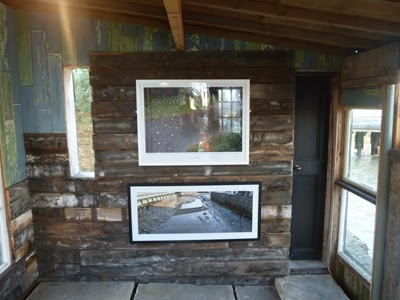
The photos of the two Creekery installations were also featured in the foyer at Arthub's Deptford X show "Boom" (27th September – 6th October 2013).


Apple Tree was shown at 8 Studios From Here, a group show of work made by artists in eight different Deptford studios during Deptford X 2013. 


Postcards from China and Stoke are being shown in Made in Greenwich gallery as part of a group show until mid-November 2013. This show was not part of Deptford X but ran concurrently.


In July, I was also part of a group show "Eight Minutes From Here", which was in turn part of My Deptford, in the Festival of Neighbourhood at the Royal Festival Hall, South Bank. I showed an old piece Sixteen Grocers.


In June, I was part of Creekside Ahoy at Arthub Gallery, a postcard auction show for which I submitted three small new linocuts.


Sunday, December 30, 2012

Christmas cards


This year I decided to make a limited edition lino-cut. Having not done any print making for a very long time, it was a steep learning curve. First I had to track down some block inks – ultramarine was relatively easy to locate, but silver proved more illusive. Cornellisen's came up trumps finally, whilst the paper came from Atlantis.

I bought two thicknesses of Khadi Cotten Rag and wanted to use the thicker 320gms, but that involved an expensive afternoon at Thames Barrier Print Studios, hiring the use of their almost clapped out old press – with mixed results, and unfortunately there wasn't time to put on a second colour.

The edition was ultimately produced in my studio with a hand roller on the thinner paper. A test showed the ultramarine needed some black in the mix to create a stronger colour.


The mis-registering was deliberate – the white show-through on the silver layer meant to convey snow sitting on the 'fruit'.


Monday, November 19, 2012

The Fragments Conference


Beatrice Bazell runs an academic reading group called 'Fragments' at Birbeck College London, which she says, 'studies the incomplete, broken, partial or refracted'. She wrote to me to ask if it was OK to use an image of my work she'd spotted on this blog (see the 2008 post) to help advertise an event she's holding for her PhD students in early December.

Of course I said yes. In the event description, Beatrice credits the work: "the image is from thewillowpatternproject.blogspot.co.uk which showcases the stunning (and very pertinent) work of the artist Sue Lawes, reproduced by kind permission."

The event details are here, and hopefully I can join them on the day.


Monday, August 20, 2012

Thursday, August 16, 2012

Calla and Cauldrons


Originally I'd wanted to model the "Old Blue & White" flowers on Calla lillies, but had to modify the idea so that the flowers could face out vertically to be seen from a distance.

As I made more of them (with a copper wire armature), they became, co-incidentally, a similar shape to the "flowers" that then later appeared as part of the London 2012 Olympic cauldron.


The Guardian on "Betty" the Cauldron...
Along with the Queen, Daniel Craig and a cast of thousands, the Olympic cauldron acquitted herself elegantly at the opening ceremony, raising her fiery petals at the end of the night to form a perfect dandelion of flame and set a new standard for understated first-night aesthetics.
The cauldron's creator, the designer Thomas Heatherwick, resisted the temptation to join the global cauldron race, opting for grace and originality over sheer bulk.

The 8.5-metre-tall cauldron, which was crafted in a workshop in Harrogate, North Yorkshire, was intended to stand apart from the fiery troughs that had come before it.

"We were aware cauldrons had been getting bigger, higher, fatter as each Olympics happened and we felt we shouldn't try to be even bigger than the last ones," he said. Betty's design, Heatherwick added, had also allowed the organisers to stress the diverse but united spirit of the Games.

"This incredible event has 204 nations coming together, so we had a child from each country bringing these copper polished objects in."
www.guardian.co.uk/sport/2012/jul/29/betty-cauldron-olympic-stadium

Not reported was that the gas supply to the cauldron cost £5K a minute. (The lighting for the stadium cost £10K a minute)...Hopefully official "energy" sponsor, EDF, paid for that!


Friday, August 3, 2012

Old Blue and White at DX Opening

Deptford X Opening, last Thursday 26th July, at Creekside Centre. A few words from RH Dame Joan Ruddock and the very gracious lead curator Hew Locke. Flowers in foreground...


Wednesday, July 25, 2012

Installing The Old Blue & White (2)

More flower arranging today...Emma Redstone came to help, along with David.


The History Bit: Origins of Blue and White

Copyright Trustees of the British Museum

Extracts from the transcript from the BBC Radio 4 series The History of the World in 100 Objects

Episode 64 - The David Vases

The David Vases (made in 1351). Porcelain; from China
"In Xanadu did Kubla Khan
A stately pleasure-dome decree:
Where Alph, the sacred river, ran
Through caverns measureless to man
Down to a sunless sea."

The thrilling opening lines of Coleridge's opium-fuelled fantasy still send a tingle down the spine. As a teenager I was mesmerised by this vision of exotic and mysterious pleasures, but I'd no idea that Coleridge was in fact writing about a historical figure. Because Qubilai Khan is a thirteenth-century Chinese emperor and Xanadu merely the English form of Shangdu, his Imperial summer capital. Qubilai Khan was the grandson of Genghis Khan, ruler of the Mongols from 1206 and terror of the world. Wreaking havoc everywhere, Genghis Khan established the Mongol Empire - a superpower that ran from the Black Sea to the Sea of Japan and from Cambodia to the Arctic. Qubilai Khan, his grandson, extended the Empire and became Emperor of China, which leads us to the objects for this programme.

Under the Mongol emperors, China developed one of the most enduring and successful luxury products in the history of the world, a product fit for stately pleasure-domes, but which spread in a matter of centuries from grand palaces to simple parlours all over the world... it's Chinese blue-and-white porcelain. We now think of blue-and-white as quintessentially Chinese, but as we shall discover, this is not how it began. This archetypal Chinese aesthetic comes in fact from Iran.

The importance of Chinese porcelain is hard to over-estimate. Admired and imitated for over a thousand years, it's influenced virtually every ceramic tradition in the world, and it's played a star role in cross-cultural exchanges. In Europe, blue-and-white porcelain is practically synonymous with China. And we've always associated it with the Ming Dynasty. But it was the David Vases, now in the British Museum, that made us re-think this history, for they predate the Ming and were in fact made under Qubilai Khan's Mongol Dynasty, known as the Yuan, who controlled all of China until the middle of the fourteenth century.

Seven hundred years ago most of Asia and a large part of Europe were reeling from the invasions of the Mongols. We all know Genghis Khan as the ultimate destroyer and the sack of Baghdad by his son still lives in Iraqi folk memory. Genghis's grandson Qubilai was also a great warrior, but under him Mongol rule became more settled and more ordered. As Emperor of China, he supported scholarship and the arts, and he encouraged the manufacture of luxury goods. Once the Empire was established, a 'Pax Mongolica' ensued, a Mongolian peace which, like the Pax Romana, ensured a long period of stability and prosperity. The Mongol Empire spread along the ancient Silk Road and made it safe. It was thanks to this Pax Mongolica that Marco Polo was able to travel from Italy to China, and then return to tell Europe what he'd seen. And one of the startling things he'd seen was porcelain.

The David Vases are so-called because they were bought by Sir Percival David, whose collection of over one and a half thousand Chinese ceramics is now in a special gallery at the British Museum. ... These two vases are obviously luxury porcelain production, made by artist-craftsmen delighting in their material.

Porcelain is a special ceramic fired at very high temperature: 1200-1400 degrees centigrade. The heat vitrifies the clay, so that like glass it can hold liquid, in contrast to porous earthenware. And the heat also makes it very tough. White, hard and translucent, porcelain was admired and desired everywhere, well before the creation of blue-and-white.

The very word 'porcelain' comes to us from Marco Polo's description of his travels in Qubilai Khan's China. The Italian 'porcellana', 'little piglet', is a slang word for cowrie shells. They do indeed look a little like curled-up piglets. And the only thing that Marco Polo could think of, to give his readers an idea of the shell-like sheen of the hard, fine ceramics that he saw in China, was a cowrie shell, a 'porcellana'. And so 'little piglets', porcelain, we've called it ever since - that's if we're not just calling it china. I don't think there's another country in the world whose name has simply become interchangeable with its defining export.

The savagery of the Mongol invasion destabilised and destroyed local pottery industries across the Middle East, especially in Iran. So when peace returned, these became major markets for Chinese exports. And in these new markets blue-and-white ware had long been popular. So the porcelain the Chinese made for them mirrored the local style, and Chinese potters used the Iranian blue pigment, cobalt, to meet local taste. The cobalt from Iran was known in China as 'huihui qing' - 'Muslim blue' - clear evidence that the blue-and-white tradition is Middle Eastern and not Chinese. Here's Craig Clunas, an expert on Chinese cultural history:

"Iran, and what's now Iraq, are the kind of areas where this sort of colouring comes in. This is a technique that comes from elsewhere, and therefore it tells us something about this period, when China is unprecedentedly open to the rest of Asia as part of this huge empire of the Mongols, which stretches all the way from the Pacific almost to the Mediterranean. Certainly the openness to the rest of Asia is what brings about things like blue-and-white, and it probably had an impact on forms of literature. So from the point of view of cultural forms coming into being, the Yuan period is extraordinarily important."

We're told that the vases were purpose-made to be offered as donations at a temple, and that the name of their donor is Zhang Wenjin, who describes himself with great solemnity as a disciple of the holy gods. It gives his home town, Shuncheng in what is now Jiangxi province, a few hundred miles south-west of Shanghai. He was offering these two grand vases along with an incense-burner - the three would have formed a typical set for an altar. The incense-burner has been lost, or at least has not yet been found. ...

Foreign rulers, the Mongols; foreign materials, Muslim blue; and foreign markets, Iran and Iraq; all played an essential part in the creation of what to many outside China is still the most Chinese of objects, blue-and-white porcelain. Soon these ceramics were being exported from China in very large quantities, to Japan and south-east Asia, across the Indian Ocean to Africa and the Middle East. And far beyond that. Here's author Jenny Uglow:

"Then it comes to Europe, and the Dutch adapt it to their life, and so it comes to Britain, and we adapt it to the forms of jugs we like, the plates we love, and so on. It becomes translated, it's like a wonderful language which is perpetually translated to the culture where it's arriving and is loved. People say it's a very, sort of, elemental thing: it's blue and white, it's the blue sky and the white clouds, or the blue sea and the white sand. And behavioral psychologists who've looked at the way people react to colour say that blue and white is seen as immensely serene and relaxing. But I think also it has to do with the great long history - you know, a thousand years of history - and the way that the blue-and-white designs themselves seem to be mysterious and 'other' and have their own stories as well. It's a combination of colour appeal and historical appeal."

So, eventually, centuries after its creation in Muslim Iran, and its transformation in Mongol China, blue-and-white arrived in Europe and triumphed. Willow-pattern, the style that many people think of when blue-and-white is mentioned, was invented in England in the 1790s by Thomas Minton, and it was as much a fantasy view of China as Coleridge's poem. It was an instant success, and Coleridge may indeed even have been drinking his tea out of a willow-pattern cup as he emerged from his opium dream.

Blue-and-white porcelain was the first truly global luxury product, and one that could be infinitely adapted to suit all local tastes. The David Vases, the earliest dateable blue-and-white, were made as offerings to the gods; in the next programme we're with another high-status object, also used as a means of connecting with the supernatural... it's a ritual throne from the Caribbean.

Tuesday, July 24, 2012

Installing The Old Blue And White

Last Sunday, Dave Aylward came to assist me in the second phase of installation (there will be a third before the Deptford X Launch on Thursday). Nick Bertram, Creekside Discovery Centre's resident conservationist, took some pictures.

It looks like it is going to be very hard to make good photographic documentation of this piece as a whole, since so far any photos taken from a distance are seriously underwhelming...


Wednesday, July 18, 2012

Deptford X 2012 (Fringe)

Have been making the 'flowers' for my Deptford X Fringe installation "The Old Blue & White" for the past two to three weeks (when not doing paid design work).

Have made two hundred so far, need a lot more. Emma Redstone has fashioned a steel 'spike' for me to hammer into the ground at the site to make holes to plant the flowers in – it is a brownfield site with little or no topsoil (a great environment for wild flowers).


Wednesday, June 20, 2012

Application for Deptford X 2012


In May I submitted a proposal to Deptford X to install some ceramic 'flowers' in Creekside Discovery Centre, which was accepted. Suddenly, though, I've got a lot of design work on (www.fivetonine.co.uk), so am worried I won't have time to complete the project.

Leila Galloway has since drawn my attention to a Shape Arts artist, Paul Cummins, who has done something similar (though completely different). Paul is a Midlands-based ceramic artist who creates, among other things, glazed flower heads with which he has made large-scale installations for Chatsworth House and other places. See Shape Arts.